Kontor MCP Model Context Protocol server
Document
KONTOR-DoC
Edition
1.0.4
Issued
2026-08-26
Licence
Apache-2.0

Declaration of Conformity

Konformitätserklärung · für einen MCP-Server zur elektronischen Rechnungsstellung

Kontor MCP is an open-source server that gives AI assistants — Claude Desktop, Claude Code, any MCP client — the ability to parse, validate, audit, explain, generate and convert German and EU electronic invoices (XRechnung, ZUGFeRD / Factur-X, EN 16931) using the official KoSIT and CEN rule sets, entirely offline. No invoice data ever leaves the machine.

Status
Active
v1.0.4
2026-08-26
Listed as io.github.DashankaNadeeshanDeSilva/kontor-mcp in the Official MCP Registry at registry.modelcontextprotocol.io.
Static record

Attestations

  1. Listed in the Official MCP Registry Namespace ownership proven via GitHub OIDC; npm package ownership via mcpName; container image via the io.modelcontextprotocol.server.name label.
    active · API record
  2. Published on npm with build provenance @kontor-mcp/rules, core, server, client, released only by a tag-triggered GitHub Actions workflow through npm trusted publishing (OIDC, no long-lived tokens); Sigstore attestations on every version.
    provenance · npm
  3. Conformant with the KoSIT XRechnung validator Same verdict and the same findings as KoSIT validator 1.6.3 on the complete XRechnung 3.0.2 test suite (86 official files + 3 fixtures). Re-checked as a CI gate on every commit.
    89 / 89 · report
  4. Generated ZUGFeRD PDFs pass PDF/A-3b and Mustang checks veraPDF 1.30.2 profile PDF/A-3b, zero violations; Mustang CLI 2.26.0 accepts every generated hybrid invoice.
    6 / 6 · 6 / 6
  5. Zero network calls at runtime: proven, not promised A test blocks sockets, DNS, TLS, http(s) and fetch across every tool, resource and prompt and asserts zero attempts; CI additionally audits inside a --network none container. No accounts, no API keys, no telemetry.
    0 attempts · test
  6. Continuously verified across platforms 357 tests; Ubuntu, macOS and Windows × Node 20 and 22; lint, PDF/A, conformance, security-audit and Docker smoke jobs on every push.
    357 tests · CI
  7. Open source under Apache-2.0 Bundled third-party artefacts keep their licences: KoSIT (Apache-2.0), CEN EN 16931 (EUPL-1.2), Liberation Fonts (OFL 1.1), all with provenance and checksums.
Section 1 — Scope

Why an offline e-invoice server matters now

Germany's Wachstumschancengesetz turns electronic invoicing from an option into an obligation. An e-invoice is not a PDF: it is XML governed by EN 16931 (about 160 business terms and more than 100 business rules) in two syntaxes (UBL 2.1 and CII D16B), narrowed by the German profile XRechnung (KoSIT), or embedded as a hybrid PDF/A-3 (ZUGFeRD / Factur-X).

An invoice that fails those rules can jeopardise input-VAT deduction, and the validator's language ([BR-DE-15] Buyer reference MUST be provided) means nothing to the people who receive it. At the same time, invoices carry personal data, bank details and prices, so GDPR and procurement policy push processing on-premises, while the existing tooling for AI agents is either a cloud API wrapper or a partial, hand-rolled validator.

Kontor MCP closes that gap: authoritative (the official Schematron rule sets, unmodified), fully offline, and complete for agent workflows, from a plain-language verdict with fix hints to generating a valid invoice from structured data.

Mandate timeline (Germany, B2B)

  • B2G suppliers must submit XRechnung with a Leitweg-IDFederal portals ZRE / OZG-RE
  • Every business must be able to receive EN 16931 e-invoicesIn force
  • Businesses with turnover above €800,000 must issue e-invoicesPrior-year turnover
  • All businesses must issue e-invoices for domestic B2BPaper and plain PDF no longer permitted

Dates and thresholds as recorded in the bundled legal timeline (primary sources, last verified 2026-08-25). Informational, not legal advice.

Section 2 — Object of the declaration

What the server exposes

Eight MCP tools, four resource families and three prompts. Every tool takes and returns Zod-validated structured content plus a human summary; findings carry the official rule identifier, a DE/EN explanation and a fix hint.

ToolPurposeEffect
validate_invoiceXSD + official EN 16931 / XRechnung rules + plausibility checks; KoSIT-equivalent verdictread-only
audit_invoiceOne-call audit with an accept / review / reject recommendationread-only
parse_invoiceDetect the format (UBL, CII, ZUGFeRD PDF) and return the EN 16931 semantic modelread-only
explain_ruleExplain any rule id (BR-*, BR-DE-*, BR-CO-*…) with DE/EN text and a fix hintread-only
check_obligationsWho must do what, from when, under the German mandate, with sourcesread-only
list_capabilitiesFormats, bundled standard versions, knowledge-base stats, sovereignty statementread-only
generate_invoiceStructured data → validated XRechnung 3.0 UBL or ZUGFeRD 2.3 / Factur-X PDF/A-3 (EN16931, BASIC, EXTENDED profiles)writes file
convert_invoiceExtract XML from a ZUGFeRD PDF, convert UBL ↔ CII, render an HTML previewwrites file

Resources

kontor://samples/{name} · kontor://reference/rules · kontor://reference/codelists/{list} · kontor://reference/cheatsheet

Prompts

audit-incoming-invoice · draft-supplier-rejection · create-invoice-interview

Section 3 — Installation and operation

How it runs

Two transports from one binary. stdio for desktop assistants: the client starts the server as a child process, nothing listens on the network. Streamable HTTP for shared or containerised deployments: an Express endpoint bound to loopback, bearer-token protected, one session per Mcp-Session-Id. Requires Node ≥ 20; no Java, no native modules.

  1. Claude Desktop Settings → Developer → Edit Config, add the block on the right, quit and reopen. Then ask: "Ist diese Rechnung gültig?" with a local file path.
  2. Claude Code claude mcp add kontor -- npx -y @kontor-mcp/server
  3. Any MCP client point it at npx -y @kontor-mcp/server (stdio) or run the container and connect to http://127.0.0.1:3333/mcp.
Run (stdio, zero install)
npx -y @kontor-mcp/server
Claude Desktop config
{
  "mcpServers": {
    "kontor": {
      "command": "npx",
      "args": ["-y", "@kontor-mcp/server"]
    }
  }
}
Container (Streamable HTTP, loopback only)
docker run -d -p 127.0.0.1:3333:3333 \
  -e KONTOR_AUTH_TOKEN="$(openssl rand -hex 24)" \
  ghcr.io/dashankanadeeshandesilva/kontor-mcp
Reference client: one-shot audit from the shell
npx -y -p @kontor-mcp/client kontor-agent audit invoice.xml
Section 4 — Evidence of operation

In Claude Desktop, offline

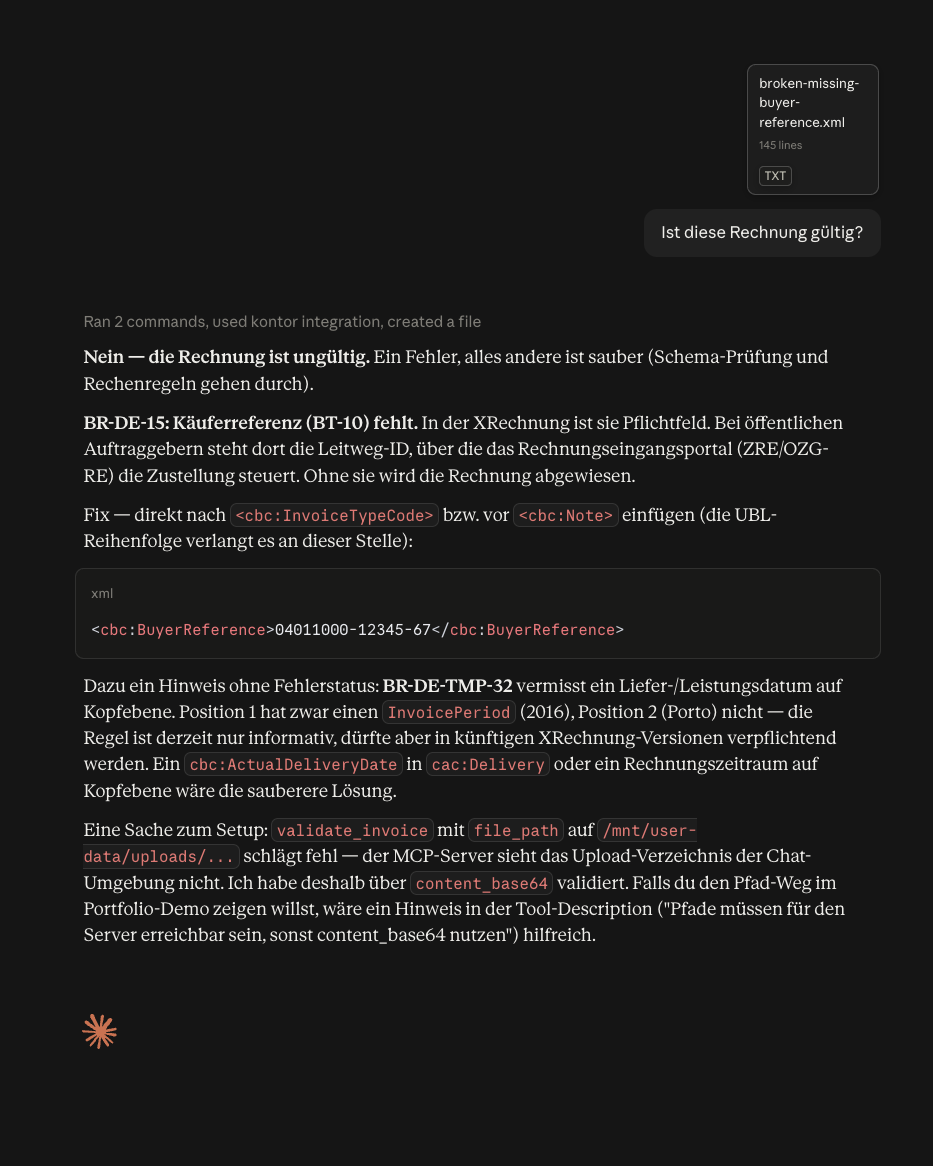
Claude Desktop conversation: a broken invoice is validated, the verdict is UNGÜLTIG and rule BR-DE-15 is explained with a fix
validate_invoice on an invoice missing its buyer reference: verdict UNGÜLTIG, BR-DE-15 explained in German with the Leitweg-ID fix.
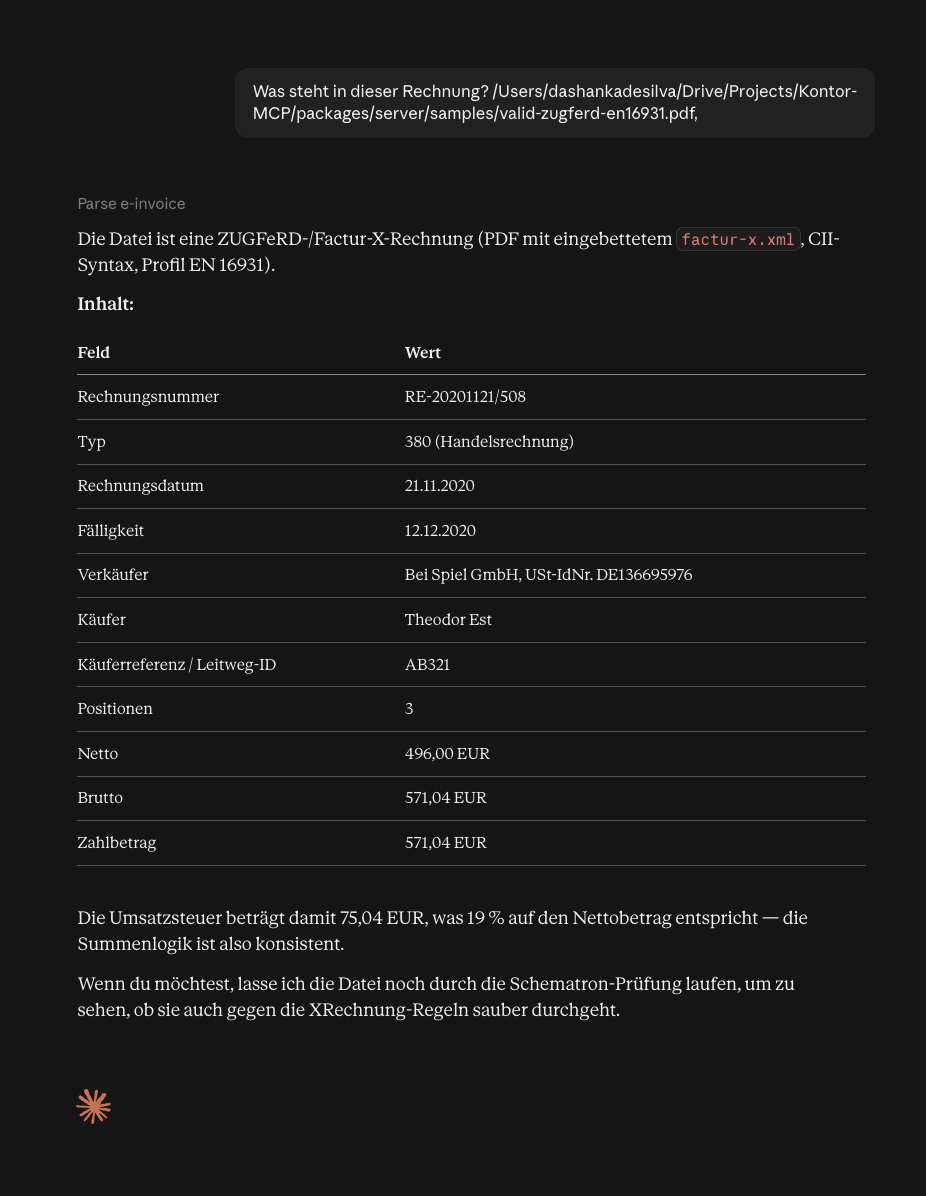
Claude Desktop conversation: a ZUGFeRD PDF is parsed and its header, parties and totals are summarised
parse_invoice on a ZUGFeRD PDF: embedded CII XML extracted, EN 16931 profile detected, totals and parties summarised.
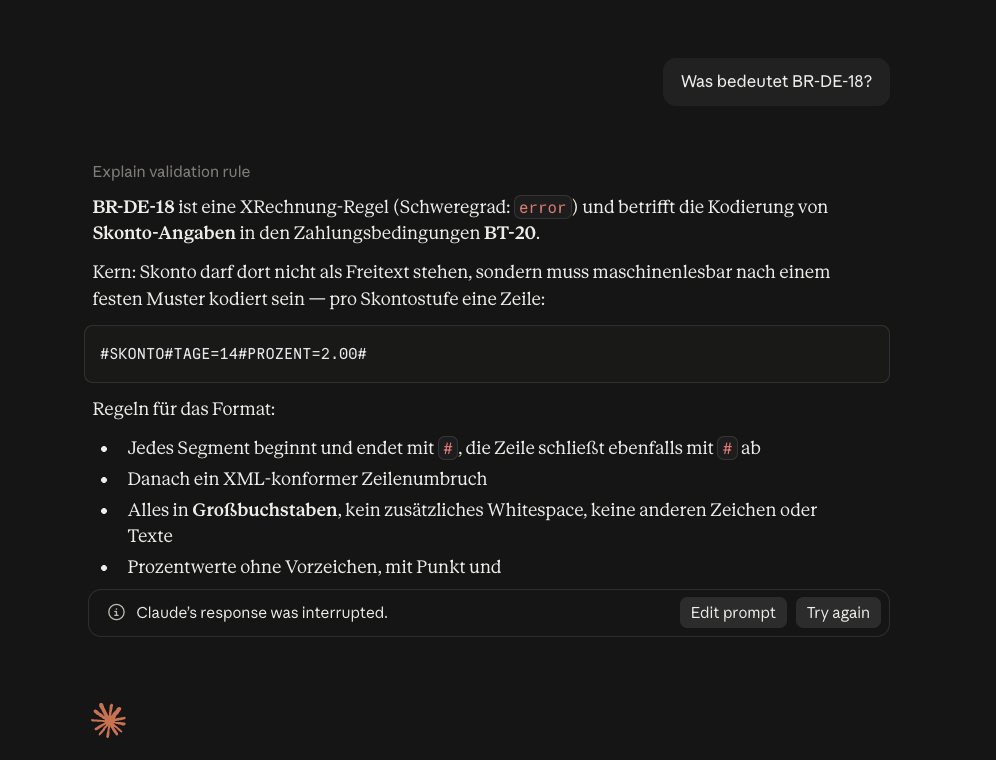
Claude Desktop conversation: the rule BR-DE-18 is explained including the required Skonto format
explain_rule for BR-DE-18: the mandated #SKONTO#TAGE=n#PROZENT=n.nn# payment-terms format, from the bundled rule knowledge base.

43-second recording of the three scenes above in Claude Desktop, network disabled. Earlier build (v0.1); the tool surface is unchanged.

Annex A — Data sovereignty and security

What the server guarantees

  • No runtime network accessAll rule sets, schemas, code lists and fonts are bundled with provenance and SHA-256 checksums. Enforced by test and by a no-network CI container.
  • Stateless; nothing stored or loggedInvoice payloads are never written to disk or logs unless KONTOR_LOG_PAYLOADS is explicitly enabled.
  • Hardened XML parsingDTDs and external entities disabled on every parse (XXE, billion-laughs), depth and size caps, path hygiene, PDF bytes treated as untrusted.
  • Exact money arithmeticAll amounts use decimal.js; floating point is never used for totals, VAT or rounding checks.
  • HTTP mode defence in depthBearer token with constant-time comparison, Origin allow-list, Host validation against DNS rebinding, loopback bind by default, session cap and 30-minute idle expiry. TLS terminates at your reverse proxy.
  • Supply chainTag-triggered releases only; npm trusted publishing with Sigstore provenance; multi-arch image built in CI, non-root, ~70 MB.

Annex B — Bundled standards

ArtefactVersion
XRechnung specification / CIUS (KoSIT)3.0.2
XRechnung Schematron (KoSIT), run unmodified2.5.0
KoSIT validator configuration2026-01-31
CEN EN 16931 Schematron1.3.16
UBL 2.1 and CII D16B XML schemas
EN 16931 code lists with DE/EN names13
Rule knowledge base entries (generated + curated)1,642 + 50
Kontor plausibility rules (KONTOR-PLAUS-*)22
ZUGFeRD / Factur-X output profiles2.3 · EN16931, BASIC, EXTENDED

Schematron is compiled to XSLT/SEF and executed with Saxon-JS; schemas via xmllint-wasm; PDF/A-3 via pdf-lib. Every artefact's source, version, date, licence and checksum is recorded in PROVENANCE.md.

Kontor MCP validates and explains e-invoices; it does not provide legal or tax advice. XRechnung is a standard of the German Koordinierungsstelle für IT-Standards (KoSIT); ZUGFeRD is a standard of FeRD; the Model Context Protocol and its registry are projects of the MCP community. Kontor MCP is not affiliated with or endorsed by any of them.